
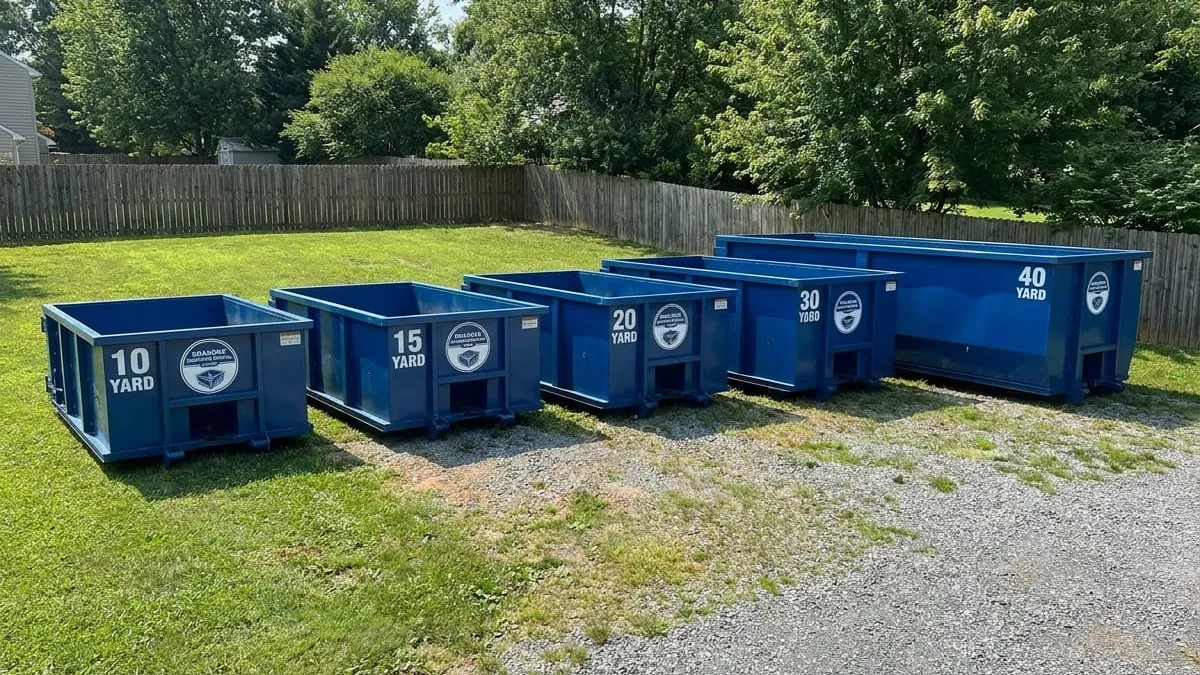
Compare all five sizes
Dumpster Sizes in Roanoke, VA — 10, 15, 20, 30 & 40 Yard
Five roll-off sizes, and the honest version of which one you actually need. In the Roanoke Valley two things decide it: what the debris weighs — broken concrete, brick, block, crawlspace spoil and termite-rotted sill plate and band joist all run heavier than they look — and how the ground sits, because a driveway cut into a hillside decides where a box can be set down long before volume does.
All sizes
Pick by weight first, volume second
Scroll the table on mobile. If your load includes concrete, block, brick, roofing shingle, crawlspace spoil or wet rotten framing, start at the 10 yard no matter how big the job looks — weight fills those long before volume does. Sizing charts written for flat markets miss two things about this valley. The first is the ground: footings go below frost, and Roanoke publishes two numbers in the same set of local climatic design criteria — 18 inches in the City of Roanoke and 24 inches in Roanoke County, Vinton and Salem. Two footing depths, four miles apart, so always check the number for the locality you are actually building in. The second is the house. Crawlspaces are common here and plenty of older city houses have basements, and with termite infestation probability rated SEVERE across the City, the County, Vinton and Salem, the signature local job is sill plate, band joist and subfloor replacement — a small box of heavy, wet, rotten framing. The City of Roanoke says 55 percent of its housing was built before 1960, across 44,543 units split roughly half owner and half renter, so city work skews to turnovers and cleanouts in foursquares, craftsman bungalows and folk Victorians. Roanoke County housing is newer and mostly owner-occupied, and the constraint out there is the approach rather than the street: a long gravel lane, a gate, a limb over the drive, or a driveway cut into the side of a ridge that a loaded box cannot be dragged back up.
| Size | Capacity | Footprint | Weight allowance | Holds about | Best for |
|---|---|---|---|---|---|
| 10 Yard Dumpster | 10 yd³ | 12 ft x 8 ft x 3.5 ft | 2 – 3 tons | ~3 pickup truck loads | Concrete, block, brick and termite-rotted framing — and the box that fits a steep or narrow drive. |
| 15 Yard Dumpster | 15 yd³ | 16 ft x 8 ft x 4 ft | 2 – 3 tons | ~4 – 5 pickup truck loads | A single room, a small tear-off, or one unit of a city rental turnover. |
| 20 Yard Dumpster | 20 yd³ | 22 ft x 8 ft x 4.5 ft | 3 – 4 tons | ~6 – 8 pickup truck loads | A crawlspace and attic clear-out — the Roanoke default — or a multi-room remodel. |
| 30 Yard Dumpster | 30 yd³ | 22 ft x 8 ft x 6 ft | 4 – 5 tons | ~9 – 12 pickup truck loads | A whole-house cleanout or a large county remodel, where there is room to set it. |
| 40 Yard Dumpster | 40 yd³ | 22 ft x 8 ft x 8 ft | 5 – 6 tons | ~12 – 16 pickup truck loads | Commercial gut jobs and construction — it needs the most room and the flattest ground. |
10 Yard Dumpster
Concrete, block, brick and termite-rotted framing — and the box that fits a steep or narrow drive.
View this size → 15yd³15 Yard Dumpster
A single room, a small tear-off, or one unit of a city rental turnover.
View this size → 20yd³20 Yard Dumpster
A crawlspace and attic clear-out — the Roanoke default — or a multi-room remodel.
View this size → 30yd³30 Yard Dumpster
A whole-house cleanout or a large county remodel, where there is room to set it.
View this size → 40yd³40 Yard Dumpster
Commercial gut jobs and construction — it needs the most room and the flattest ground.
View this size →The two rules that decide it here
Weight beats volume on dense material, grade beats everything on a hillside drive
This is the single most useful thing on the page. A container has two limits: how much volume it holds and how much weight a truck can legally lift and carry. Light debris runs you out of volume first. Dense material runs you out of weight first, and it happens far earlier than people expect.
Around the Roanoke Valley the dense material is broken concrete, brick, block, crawlspace spoil and water-logged framing. Concrete and block run in the range of 2,400 to 2,800 lbs per cubic yard — a front walk, a patio slab, a section of foundation wall or an old carport pad will reach legal transport weight in a can that still looks half empty. Crawlspace work is the one people misjudge most: a vapor barrier tear-out brings up damp soil and rubble along with the debris, and it comes out heavier every time. Termite and rot repair is the other quiet one. Termite pressure here is rated SEVERE, and a sill plate, band joist and subfloor replacement produces a short pile of soaked, insect-eaten framing that weighs like masonry. Roofing is measured in squares and layers, never in roof area, and it is common to find a second course still sitting on the deck, which doubles the tonnage on a roof that looked like a one-can job. A tear-off in Raleigh Court or Grandin Village that looks like a 20 yard job is often a weight job rather than a volume job, and it wants a 10 yard, sometimes twice. Worth knowing too: Virginia has essentially no disposal ban list — the state regulates disposal facilities under 9VAC20-81 rather than banning materials — but lead-acid batteries are banned outright by Va. Code § 10.1-1425.1, and each battery counts as a separate violation, so they come out of the load whatever else happens. Clean masonry is worth keeping as its own load, because it goes to a crusher rather than to a disposal site.
The second rule is the one out-of-state sizing charts never mention. Grade beats everything. The valley floor sits between Mill Mountain, Read Mountain, Tinker Mountain, the Blue Ridge and the Allegheny ridges, and a real share of driveways here are steep, curved, or cut into a hillside. Grade decides whether a box can be set down at all, whether it will stay where we put it, and whether the cable can pull a loaded one back up to the street. On a steep drive the smaller box is not a compromise, it is the only box that works, and the loading rule that goes with it is simple: load flat, load low, heavy on the bottom, nothing standing proud of the top rail. Weather is the second half of it. Roanoke gets 42.82 inches of rain and 14.8 inches of snow in an average year on the 1991–2020 normals for the airport station, and rain does not blow away — it soaks into gypsum, carpet, cardboard and insulation, and water sitting in an open container is weight you pay to haul. Once anything stands proud of the rails the load cannot be tarped, which means it cannot legally be hauled either. Where the 30 and the 40 yard earn their keep is bulk with no weight in it — a shed, porch or detached garage teardown, a whole-house cleanout, an attic full of paneling and storm windows — on flat ground with room to work. Pull the scrap metal and the flattened cardboard out first, because both have a route of their own and both are cheaper out of the box than in it.
Tell us the material, the rough quantity and what the driveway looks like on the phone and we will size it properly. Getting it wrong costs us more than it costs you, so we have every reason to get it right.
How it works
From phone call to empty driveway
- 1
Call us
Tell us the project, your address and when you want it. Two minutes on the phone and you have a flat price.
- 2
We deliver
Our driver walks the drop, lays protection boards and sets the container exactly where you want it.
- 3
You load it
Take your time within your rental window. Keep it level with the top rail and we handle the rest.
- 4
We haul it
Call or text when you are done. We pull it, sort what can be recovered and dispose of the rest properly.
Choosing a Size — FAQs
Which dumpster size is most popular in Roanoke?
The 20 yard, by a wide margin. It handles a crawlspace and attic cleared out in one go, a kitchen gut or a multi-room remodel, and it still sits on a normal valley driveway. The 15 yard is next most common because it is the sweet spot for a single room, one unit of a city rental turnover or a shingle tear-off on an average house. Anything with concrete, brick, block, crawlspace spoil or rotted sill plate and band joist in it goes the other way, down to a 10 yard. On a steep or curved hillside drive the 10 is often the only box that will sit level and come back up loaded.
What size do I need for a roof tear-off?
For a Roanoke house on asphalt or dimensional shingle, a 15 or 20 yard. Roofing is weight-driven rather than volume-driven, so squares and layers decide it, not roof area — and it is common to find a second course still sitting on the deck, which doubles the tonnage. Asphalt shingles are not on any Virginia ban list, because Virginia does not really have one: 9VAC20-81 regulates disposal facilities rather than materials. What does decide who pays for the haul is local. The City of Roanoke does not collect construction and demolition debris under its solid waste chapter, City Code Chapter 14.1, so a tear-off is on the contractor or on you. Roanoke County will take small amounts of homeowner remodeling debris with bulk collection, which is the opposite answer four miles away. There is also a placement rule worth planning around: under Virginia’s Statewide Fire Prevention Code, 13VAC5-51, which adopts the 2021 International Fire Code effective 18 January 2024, § 304.3.3 keeps a container over 1.5 cubic yards at least five feet from combustible walls, openings and combustible roof eave lines. Every roll-off is bigger than 1.5 cubic yards, so five feet applies to every box we set. Older roofing felt, mastic and cement-asbestos shingle can contain asbestos, which stops the job until it is tested — in Virginia that runs through a DPOR-licensed contractor with DOLI notification, and the waste goes to a facility permitted by DEQ to take it. Our tear-off sizing guide has the full math.
Is the 40 yard just the biggest and best?
No, and treating it that way is an expensive mistake here more than most places. The 40 yard is a volume container for bulky light debris — framing, cabinetry, porch lumber, packaging and whole-house cleanouts. Put anything dense in it and you will exceed legal transport weight long before it is full. It also needs the most room and the flattest ground of anything we run, which rules it out on a driveway cut into a hillside, on a narrow street in Old Southwest or Wasena, and on the long gravel lanes out toward Bent Mountain, Catawba and Back Creek. A big open box of light material has to be loaded below the rails and covered, or the wind redistributes it down the street and the rain fills it with weight you pay to haul. On a sloped approach we will usually put two smaller boxes through rather than one 40, and it works out better for everyone.
Can I change size after I book?
Yes, as long as the truck has not been dispatched. If you describe the job and we think you have ordered wrong, we will say so before delivery rather than after. Changing on the phone costs nothing; discovering it at the scale house costs a great deal.
How much space do I need?
Roughly the container footprint plus working room: about 60 feet of straight approach for the truck, around 10 and a half feet of width, and 20 feet or more of overhead clearance while the hoist operates. Grade matters as much as space. On a steep or curved drive tell us which way it falls and how tight the turn off the street is, because that decides the size and sometimes the answer. There is also a fire code rule worth planning around. Virginia’s Statewide Fire Prevention Code is 13VAC5-51, adopting the 2021 International Fire Code effective 18 January 2024, and § 304.3.3 keeps a container larger than 1.5 cubic yards out of a building and at least five feet from combustible walls, openings and combustible roof eave lines. Every roll-off exceeds that threshold, so five feet is the number for every box. There is no state fire permit for an individual container — the fire code’s waste handling permit covers facilities, not the box in your driveway — but your local fire marshal can still have a view, so ask if you are placing on a commercial site. Keep hydrants, exits and fire-apparatus access clear. Look up before you decide: an oak or maple limb, a porch roof, a low gutter or the service drop into the house will stop the arm cold. Tell us what the approach looks like and we will bring the right box.
Services
What people put in them
Residential Dumpster Rental
Driveway placement for the crawlspace, attic and basement cleanouts an older valley house produces.
Learn more →Commercial Dumpster Rental
Containers for businesses and contractors — the City of Roanoke does not collect construction debris.
Learn more →Construction Dumpster Rental
Mixed C&D in one roll-off, with next-day swap-outs across the Roanoke Valley.
Learn more →Roofing Dumpster Rental
Weight-rated cans sized by squares and layers, set five feet off the eave line.
Learn more →Roll-Off Dumpster Rental
10, 15, 20, 30 and 40 yard roll-offs across Roanoke, the county, Salem and Vinton.
Learn more →Same-Day Dumpster Rental
Call before the cut-off and we can usually get a container to you this afternoon.
Learn more →Talk to a real person
Not sure which size you need?
Tell us what you are clearing out and we will tell you the right size and the flat price to put it in your driveway. No forms, no waiting on an email — just call and we will sort it out in a couple of minutes.
Serving Roanoke, the Roanoke Valley and Southwest Virginia · Mon–Fri 6:30am–5pm, Sat 7am–1pm