
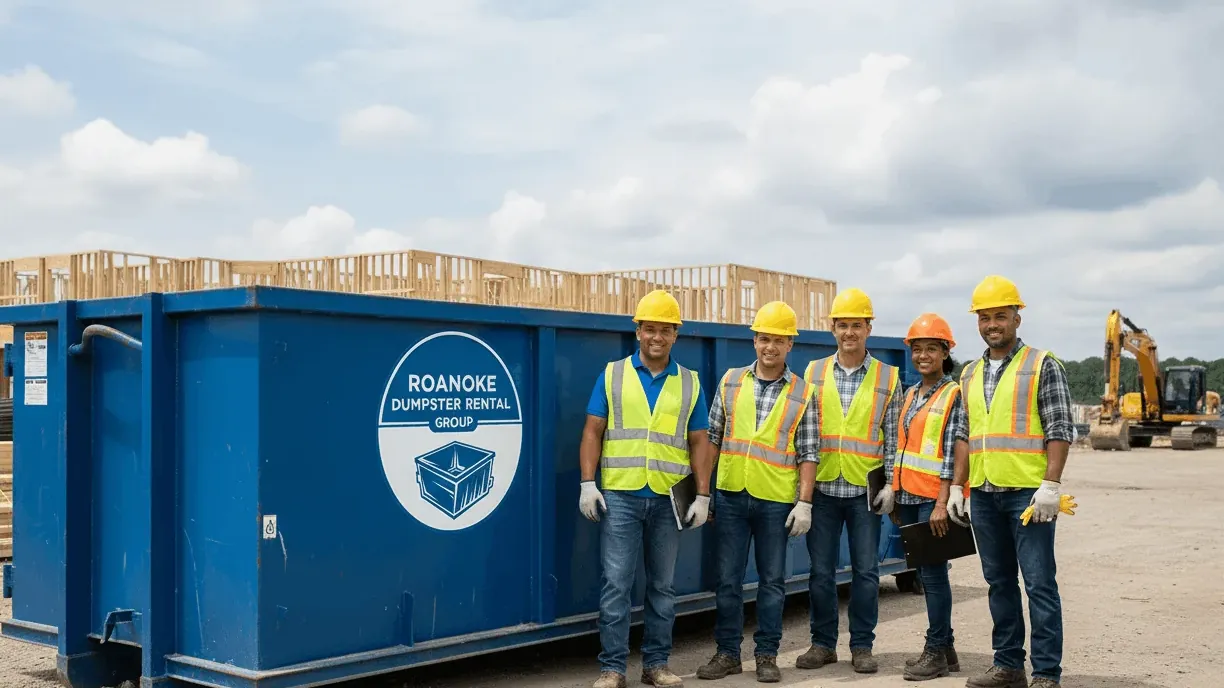
Demolition
Demolition Debris Removal in Roanoke
Garages, additions, interior gut jobs and outbuildings. In Virginia a demolition needs a locate ticket and ten working days’ notice to the state before it starts, and a pre-1985 building may need an asbestos inspection before the permit issues.
Two phone calls come before the first swing, and neither of them is to us. The first is a locate request. Virginia’s Underground Utility Damage Prevention Act says no person shall make or begin any excavation or demolition without first submitting a locate request to the notification center, and it defines demolition to mean any operation by which a structure or mass of material is wrecked, razed, rendered, moved or removed. That is the part people miss: 811 in Virginia is not only about digging. The timing is set by Va. Code § 56-265.19 A, which says the scheduled excavation date shall be “not less than 48 hours nor more than 12 working days” from the request. The ticket runs 15 working days. The operator is Virginia 811, which many people here still call Miss Utility, at va811.com.
The second call is to the Virginia Department of Labor and Industry. DOLI has to be notified at least ten working days before the start date of a demolition, and that applies to most buildings whether or not there is any asbestos in them. Contractors moving into Virginia from other states are regularly caught by this one, because it is a notification requirement attached to demolition itself rather than to a hazardous material. Keep the three state agencies straight and the whole sequence becomes manageable: DPOR licenses the people and firms who do asbestos and lead work, DOLI takes the notifications and issues project permits, and DEQ governs where the waste ends up under 9VAC20-81. DPOR licenses, DOLI notifies, DEQ handles disposal. Get those three in the right order at the start of a job and the rest of the paperwork follows without drama; get them in the wrong order and you find out at the permit counter.
Then there is the permit gate itself. Va. Code § 36-99.7 stops a local building department issuing a permit for a building whose initial building permit was issued before 1 January 1985 to be renovated or demolished until it receives certification from the owner or the owner’s agent that the affected portions have been inspected for the presence of asbestos by an individual licensed to perform such inspections. The residential carve-out is narrow and deserves quoting rather than summarizing: the provisions shall not apply to single-family dwellings or residential housing with four or fewer units, unless the renovation or demolition of such buildings is for commercial or public development purposes. So an ordinary house coming down for a family is one situation, and the same house coming down for a development is another. Ask the building official in your locality, because the City of Roanoke, Roanoke County, Salem and Vinton each run their own building department.
Demolition debris in this valley has a local flavor, and termites are most of it. Roanoke City, Roanoke County, Vinton and Salem are all designated SEVERE for termite infestation probability in the local design criteria, and combined with crawlspace construction and humid summers that produces a steady supply of sill plate, band joist and subfloor work. Taking out rotten framing is technically demolition, and it makes a load that fools people: short lengths, full of nails, often damp, and much heavier per cubic yard than clean lumber. Put it in a small box loaded flat rather than a large one loaded high. The same goes for anything with masonry in it. Our termite and rot debris guide works through what to expect once the crawlspace hatch is open. Sort it into its own container rather than letting it ride with the framing, because a small box of wet, nail-studded sill plate is a very different load from a large box of clean lumber.
For sizing, separate what the building is made of before you order anything. Framing, roof decking, siding and interior board are airy and belong in a 30 or a 40. Foundations, footings, block, brick, chimney and slab are dense and belong in a 10 or a 15 loaded flat and low. Virginia’s own regulation makes the same distinction: 9VAC20-81-10 defines demolition waste as what the destruction of structures and their foundations produces, and debris waste as land-clearing material including stumps, wood, brush, leaves, soil and road spoils. Those are different containers on most sites. One more consideration is peculiar to this valley: the ground is karst, so a heavily loaded container is a point load on soil that may be bridging a void. Tell us where the concrete is going and we will place the boxes accordingly.
Demolition Work We Load
Detached Garage Or Shed
The commonest small demolition here. Framing, roof decking, shingles and a slab, which is really two loads rather than one and worth splitting before you start.
Interior Gut Job
Board, plaster, trim, cabinetry, flooring and ceilings back to the studs. Volume-led until the tile and the mortar bed come out, and then it is a weight job.
Additions And Porch Removal
A rear addition, a rotted porch or an enclosed sun room coming off. Old porches on hillside lots often sit on piers, so the masonry comes with it.
Termite And Rot Tear-Out
Sill plate, band joist, joist ends and subfloor. Short, nail-studded, often damp and far heavier per yard than the clean lumber it replaces.
Chimney And Fireplace
Brick, block, flue liner and mortar. Dense, awkward and the classic case for a small box loaded flat rather than a large one loaded high.
Foundation And Slab
Footings, block walls, garage slabs and porch piers. Tell us what is spoil and what is masonry at booking, because the two are not the same load.
Outbuildings And Fencing
Barns, workshops, chicken coops and long runs of fence. Treated lumber and fencing are excluded from City of Roanoke curbside collection entirely.
Fire And Water Loss
Burnt or saturated structure. Wet framing and charred material both weigh far more than they look, and both want a smaller container swapped more often.
Sizing A Demolition Container
Split the building by density before you order. Framing, decking, siding, cabinetry and interior board are airy: a 30 yard handles most house-scale demolition and a 40 yard suits a large gut job if you have room and flat ground for it. Foundations, footings, block, brick, chimney masonry and slab are dense: those go in a 10 or a 15 loaded flat and low, and they will reach payload while the sides are still visible. That is not the box being too small, it is the box working correctly. Running one of each is normal on a demolition and it is almost always cheaper than one container that has to be part-emptied before it can legally leave. Add a third for land clearing if stumps and soil are coming out. Dimensions sit on the container sizes page, and the yard will size it on the phone.
20 Yard Dumpster
A crawlspace and attic clear-out — the Roanoke default — or a multi-room remodel.
View this size →30yd³30 Yard Dumpster
A whole-house cleanout or a large county remodel, where there is room to set it.
View this size →40yd³40 Yard Dumpster
Commercial gut jobs and construction — it needs the most room and the flattest ground.
View this size →Before The First Swing
Work the sequence in order and a demolition here goes smoothly. Submit the locate request first: Virginia law bars beginning any excavation or demolition without one, and Va. Code § 56-265.19 A puts the scheduled date at not less than 48 hours nor more than 12 working days from the request, with the ticket valid 15 working days. Notify DOLI at least ten working days before the demolition start date, asbestos or not. If the building was first permitted before 1 January 1985, settle the § 36-99.7 asbestos inspection question with your building official before you file for the permit rather than after. Then think about placement. Karst ground and hillside drives are both real here, so we walk the set-down, board under the wheels and rails, and keep every container at least five feet from combustible walls, openings and roof eave lines under International Fire Code § 304.3.3. If a box has to stand in a City of Roanoke street, that permit needs ten calendar days’ notice and runs a maximum of 30 consecutive days.
Not sure this is the right service? Describe the job on the phone and we will point you at the right container even if it is a different service page. Call (540) 685-0739.
Get a flat quote
Two minutes on the phone gets you a size, a price and a delivery slot. No forms.
(540) 685-0739Recommended sizes
How it works
Demolition Debris Removal in four steps
- 1
Call us
Tell us the project, your address and when you want it. Two minutes on the phone and you have a flat price.
- 2
We deliver
Our driver walks the drop, lays protection boards and sets the container exactly where you want it.
- 3
You load it
Take your time within your rental window. Keep it level with the top rail and we handle the rest.
- 4
We haul it
Call or text when you are done. We pull it, sort what can be recovered and dispose of the rest properly.
Demolition Debris Removal FAQs
Do I really have to call 811 for a demolition?
Yes. Virginia is unusual in how plainly it says so. The Underground Utility Damage Prevention Act bars any person from making or beginning any excavation or demolition without first submitting a locate request, and it defines demolition as any operation by which a structure or mass of material is wrecked, razed, rendered, moved or removed by means of tools, equipment or explosives that could damage underground utility lines. Va. Code § 56-265.19 A sets the window at not less than 48 hours nor more than 12 working days from the request, and the ticket stays valid 15 working days. The operator is Virginia 811 at va811.com.
Who else has to be notified?
DOLI, at least ten working days before the start date of the demolition, and that duty applies to most buildings whether or not asbestos is present. It surprises contractors arriving from other states, so build it into the program rather than the punch list. Separately, if the building was first permitted before 1 January 1985, Va. Code § 36-99.7 may require a licensed asbestos inspection before your locality can issue the building permit at all. Three agencies split this work in Virginia: DPOR licenses, DOLI notifies, DEQ handles where the waste goes under 9VAC20-81.
Is a house always exempt from the asbestos inspection rule?
No, and this is the sentence to read carefully rather than skim. The exemption in Va. Code § 36-99.7 says the provisions shall not apply to single-family dwellings or residential housing with four or fewer units, unless the renovation or demolition of such buildings is for commercial or public development purposes. So a family taking down a garage or gutting their own house is in a different position from a developer taking down the same house to build something else, and a five-unit building is not exempt at all. Ask your building official, and note that the City of Roanoke, Roanoke County, Salem and Vinton each have their own.
Can concrete and framing go in the same container?
They can, and it is usually the expensive way to do it. Masonry reaches legal payload while the container still looks half empty, which means the framing, decking and siding you also have to move end up with nowhere to go, and you pay for a second container anyway. Split it at the start instead: a 10 or a 15 for the foundation, chimney, block and slab, loaded flat and low, and a 30 or a 40 for the airy material. On a karst valley floor there is a second reason to keep the heavy box small, because a loaded container is a concentrated point load on ground that is not always solid underneath.
What will you not take?
Asbestos, in any form and under any circumstances. In Virginia that project runs through a DPOR-licensed contractor with DOLI notification, and the waste goes to a facility permitted to take it under 9VAC20-81. Beyond that, keep out liquids, fuel, solvents, pressurized cylinders and lead-acid batteries, the last of these being the one genuine statewide disposal ban under Va. Code § 10.1-1425.1 where each battery is a separate violation. Tires are governed by a threshold rule rather than a flat ban, so ask before you load them. Everything else on an ordinary demolition is straightforward.
More services
Other things we haul
Residential Dumpster Rental
Driveway placement for the crawlspace, attic and basement cleanouts an older valley house produces.
Learn more →Commercial Dumpster Rental
Containers for businesses and contractors — the City of Roanoke does not collect construction debris.
Learn more →Construction Dumpster Rental
Mixed C&D in one roll-off, with next-day swap-outs across the Roanoke Valley.
Learn more →Roofing Dumpster Rental
Weight-rated cans sized by squares and layers, set five feet off the eave line.
Learn more →Roll-Off Dumpster Rental
10, 15, 20, 30 and 40 yard roll-offs across Roanoke, the county, Salem and Vinton.
Learn more →Same-Day Dumpster Rental
Call before the cut-off and we can usually get a container to you this afternoon.
Learn more →Junk Removal Dumpsters
Clear a crawlspace, attic, garage or basement on your own schedule.
Learn more →Estate Cleanout Dumpsters
Discreet, patient container service for families clearing a lifelong home.
Learn more →Concrete & Heavy Debris
Dedicated heavy cans for concrete, block, brick and rubble on karst ground.
Learn more →Yard Waste & Brush Removal
Separate clean loads for brush and clearance beyond what curbside will take.
Learn more →Where we deliver
Demolition Debris Removal across the Roanoke Valley and Southwest Virginia
Same service, same flat rates, every town below. Pick yours for local placement and permit notes.
Talk to a real person
Need demolition debris removal in Roanoke?
Tell us what you are clearing out and we will tell you the right size and the flat price to put it in your driveway. No forms, no waiting on an email — just call and we will sort it out in a couple of minutes.
Serving Roanoke, the Roanoke Valley and Southwest Virginia · Mon–Fri 6:30am–5pm, Sat 7am–1pm