
Commercial and construction
40 Yard Dumpster Rental in Roanoke, VA
The biggest container we run, and the one with the strictest conditions attached. It is for airy bulk in quantity: commercial gut jobs, construction sites, office churn and large fit-outs. Say plainly what it needs and half the wasted deliveries disappear, so here it is. A 40 needs the most room and the flattest ground of anything we place, and in a valley of hillside lots and short drives that is a real constraint rather than a formality.
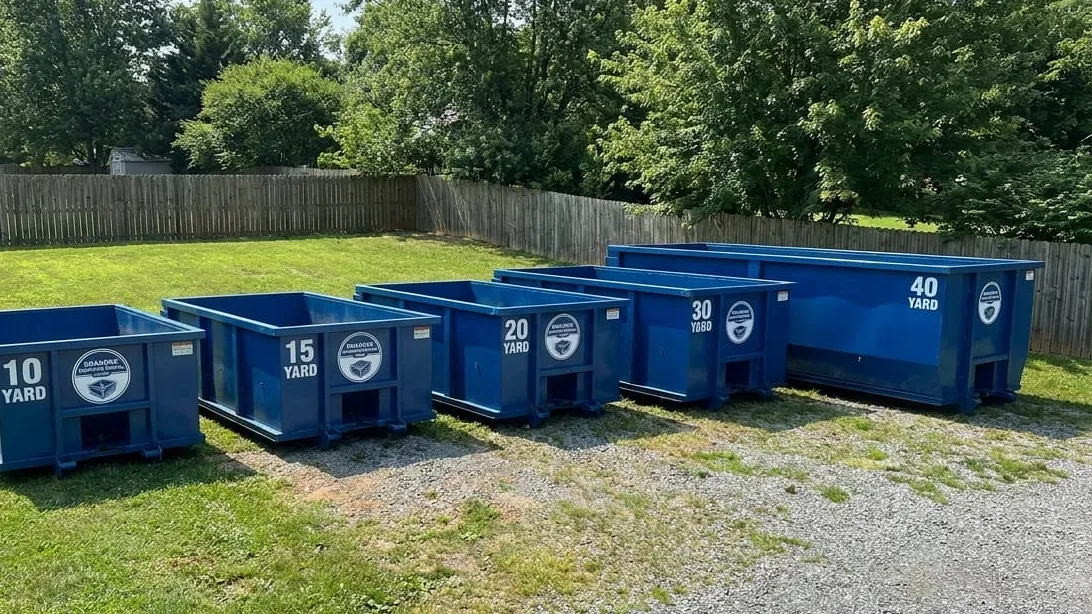
A 40 yard roll-off is roughly twenty-two feet long, eight feet wide and about eight feet tall, which is sixteen or seventeen pickup loads. The capacity is all in the height, so it takes the same ground length as a 30 and holds a third again. It is a commercial and construction container rather than a household one, and it is the box where placement, not volume, is the question we ask first.
- Capacity40 cubic yards
- Footprint22 ft x 8 ft x 8 ft
- Weight allowance5 – 6 tons
- Holds about~12 – 16 pickup truck loads
Why people choose the 40 yard
Say the constraint before the benefit, because it saves everyone a wasted morning: a 40 yard needs the most room and the flattest ground of any container we place. In the Roanoke Valley that is not a small thing. Roanoke sits on a valley floor between Mill Mountain, Read Mountain, the Blue Ridge and the Allegheny ridges, and a meaningful share of properties here have short, curved or graded drives cut into a hillside. Roll-off delivery is a gravity operation: the container slides off the rails under its own weight and the cable pulls it back up loaded. A tall box loaded high, on a slope, is the hardest set the truck does, and there are many valley addresses where the answer is simply no. On a level commercial lot, an industrial park off Peters Creek Road or a wide county site, a 40 is straightforward. Ask before you order, and we will walk it. On a residential property in this valley the honest answer is usually a 20, or two 20s, instead.
What it is for is airy bulk and nothing else. Commercial gut jobs and interior strip-outs produce ceiling grid, partitions, doors, trim, cabinetry, carpet tile, shelving and packaging in volume, all of which consume space quickly and weigh very little. Office churn is the same story with workstations and files in it. New construction produces framing offcuts, sheathing, siding, housewrap and packaging on a similar profile. In every one of those cases the 40 is the cheapest way to move the material, because the alternative is swapping a smaller container three times. Where it fails, immediately and expensively, is density. Masonry, block, brick, tile bedded in mortar, spoil, soil and anything saturated will reach the lawful payload with the box a third full, and a 40 that cannot legally move is a bigger problem than a 10 that cannot, because part-emptying it by hand is a day’s work. Sort by material before the container arrives, keep the dense debris in a small box loaded flat, and the whole job runs cheaper.
On a commercial site the container also has to satisfy the fire code and, if it stands in the street, the permit. Virginia is on the 2021 Statewide Fire Prevention Code at 13VAC5-51, effective 18 January 2024, which carries the 2021 International Fire Code. Under § 304.3.3, a container of 1.5 cubic yards or more may not be stored in a building or placed within five feet of combustible walls, openings or combustible roof eave lines. Every box we run is far above that threshold, and on a tight commercial lot that five feet is often what decides the spot. If the 40 has to sit in a City of Roanoke street, plan the calendar around the permit: the application goes in at least ten calendar days ahead, the permit runs a maximum of 30 consecutive days, and the hauler files a certificate of public liability insurance of at least one million dollars per occurrence naming the City of Roanoke as an additional insured.
Whatever the site, the material leaves the valley the same way. Waste tips at the Roanoke Valley Resource Authority’s Tinker Creek Transfer Station on Hollins Road and is then railed 33 miles by Norfolk Southern to the Smith Gap Landfill, which makes this one of the very few places in the country where construction debris leaves town on a train. Virginia’s solid waste regulation, 9VAC20-81, governs facilities rather than materials, so there is essentially no statewide banned-materials list to work around on a commercial load. The exclusions we enforce are the real ones: asbestos never, which in Virginia runs through a DPOR-licensed contractor with DOLI notification; lead-acid batteries never, under Va. Code § 10.1-1425.1 where each battery is a separate violation; and no liquids, fuel, solvents or pressurized cylinders in any container we place. Waste tires are governed by a threshold rule rather than a flat ban, so ask before you load them, and anything you are unsure about is worth one phone call before it goes in rather than one after.
Good fit for
- Commercial gut jobs and interior strip-outs
- Office churn, relocations and furniture clear-outs
- Large retail and restaurant fit-outs
- New construction framing, sheathing and siding
- Warehouse racking, pallets and packaging
- Multi-unit residential turnovers on a level site
- Large volumes of cabinetry, doors and trim
- Any airy load on a wide, flat commercial lot
Not the right size for
- Concrete, brick, block, stone or mortar rubble
- Soil, sod, crawlspace spoil and excavation material
- Roof tear-offs, which reach payload on weight alone
- Saturated contents after a water or storm loss
- Steep, short or curved hillside driveways
- Any residential drive without real turning room
Will it fit?
Be honest about the ground before you order a 40, because this is the container that gets refused on site more than any other. It takes roughly twenty-two feet of length for the box, so allow around twenty-eight feet of usable ground with the rear door swing, about ten and a half feet of width and 20 feet or more of overhead clearance for the hoist, plus around 60 feet of straight approach for the truck. What it also needs, and this is the part that matters in the Roanoke Valley, is flat, firm ground. A 40 is tall, and loaded high on a slope it is the hardest recovery the truck does, so a graded hillside drive is usually a no rather than a maybe. The ground under it counts too, because this valley is karst and a large loaded container concentrates several tons on four contact points. Plywood goes under the wheels and the rails on every set. The fire code follows the box wherever it lands: at least five feet clear of combustible walls, openings and combustible roof eave lines under International Fire Code § 304.3.3, and a City of Roanoke street placement needs ten calendar days of notice.
Before delivery, move cars and bins, mark irrigation heads and septic lids, and tell us about new concrete, soft or made ground, a steep or hillside-cut drive, or a service drop hanging under the tree canopy. Plywood goes under every wheel and under both rails as standard. Our delivery and driveway protection guide and our steep driveway guide cover the rest.
Compare all five sizes
| Size | Footprint | Weight allowance | Holds about | Best for |
|---|---|---|---|---|
| 10 Yard Dumpster | 12 ft x 8 ft x 3.5 ft | 2 – 3 tons | ~3 pickup truck loads | Concrete, block, brick and termite-rotted framing — and the box that fits a steep or narrow drive. |
| 15 Yard Dumpster | 16 ft x 8 ft x 4 ft | 2 – 3 tons | ~4 – 5 pickup truck loads | A single room, a small tear-off, or one unit of a city rental turnover. |
| 20 Yard Dumpster | 22 ft x 8 ft x 4.5 ft | 3 – 4 tons | ~6 – 8 pickup truck loads | A crawlspace and attic clear-out — the Roanoke default — or a multi-room remodel. |
| 30 Yard Dumpster | 22 ft x 8 ft x 6 ft | 4 – 5 tons | ~9 – 12 pickup truck loads | A whole-house cleanout or a large county remodel, where there is room to set it. |
| 40 Yard Dumpster | 22 ft x 8 ft x 8 ft | 5 – 6 tons | ~12 – 16 pickup truck loads | Commercial gut jobs and construction — it needs the most room and the flattest ground. |
Still not sure? Describe what you are throwing away and we will size it on the phone in two minutes. Getting it wrong costs us more than it costs you, so we have every reason to get it right. Call (540) 685-0739.
Book a 40 yard
Flat rate including delivery, pickup, rental period and disposal. Same-day where we can.
(540) 685-0739Other sizes
Popular services
All sizes
Compare our five roll-off containers
10 Yard Dumpster
Concrete, block, brick and termite-rotted framing — and the box that fits a steep or narrow drive.
View this size → 15yd³15 Yard Dumpster
A single room, a small tear-off, or one unit of a city rental turnover.
View this size → 20yd³20 Yard Dumpster
A crawlspace and attic clear-out — the Roanoke default — or a multi-room remodel.
View this size → 30yd³30 Yard Dumpster
A whole-house cleanout or a large county remodel, where there is room to set it.
View this size → 40yd³40 Yard Dumpster
Commercial gut jobs and construction — it needs the most room and the flattest ground.
View this size →40 Yard Dumpster FAQs
Will a 40 fit on my driveway?
Usually not, and we would rather say so now than send a truck that has to leave with the box still on it. A 40 needs the most room and the flattest ground of anything we run: around twenty-eight feet of usable length with the door swing, ten and a half feet of width, 20 feet of overhead clearance and roughly 60 feet of straight approach, on a surface that is level and firm. In this valley a great many drives are short, curved or graded into a hillside, and a tall loaded container on a slope is the hardest set the truck does. On most residential properties here, a 20 or two 20s is the right answer.
What can I put in a 40?
Airy material and nothing dense. Ceiling grid, partitions, doors, trim, cabinetry, carpet tile, shelving, packaging, workstations, framing offcuts, sheathing and siding are all ideal, because they fill volume quickly and weigh little. Concrete, brick, block, tile in a mortar bed, soil, spoil and anything saturated are not, because they reach the lawful payload with the container a third full. Part-emptying a 40 by hand because it is overweight is a day’s work for somebody, so sort by material before you order: dense material in a 10 or a 15 loaded flat, airy material in the 40.
Is a 40 cheaper than swapping a 30 twice?
On the right job, yes, and that is really what this size is for. If the material is genuinely airy and the site can take the container, one 40 beats two or three swaps of something smaller on both cost and disruption. If the material has any density in it, or if the site is tight, the arithmetic reverses quickly, because an overweight container costs a wasted truck movement and a container that will not fit costs a wasted delivery. Tell us what the material is and what the site looks like and we will give you a straight comparison rather than pushing the biggest box.
Do we need a permit on a commercial site?
Not on your own lot. In the public right-of-way it depends on whose street it is, and this valley has four different answers. On a City of Roanoke street it is the City’s Dumpster and Portable Storage Container Permit: applied for at least ten calendar days ahead, a maximum of 30 consecutive days, a certificate of public liability insurance of at least one million dollars per occurrence naming the City as an additional insured, cones and reflective tape at all times, a ten-foot travel lane kept open, and at least 30 feet from stop signs, stop bars, crosswalks and intersections. On a Roanoke County subdivision street the road is usually the state’s under the Byrd Road Act, so ask the VDOT Salem District.
Can we keep one on site for the whole project?
On private property, yes, and a scheduled swap is how most contractors here run it. Tell us the cadence or call the day before and we will fit the swap into the route. In a City of Roanoke street the permit caps a dumpster at 30 consecutive days, and a portable storage container at seven, which is a distinction worth knowing before you plan a long job around the curb. Wherever the container stands, the fire code stays with it: 1.5 cubic yards or more means out of buildings and at least five feet from combustible walls, openings and roof eave lines. Call the yard and we will set the schedule up.
Services
What people put in a 40 yard
Residential Dumpster Rental
Driveway placement for the crawlspace, attic and basement cleanouts an older valley house produces.
Learn more →Commercial Dumpster Rental
Containers for businesses and contractors — the City of Roanoke does not collect construction debris.
Learn more →Construction Dumpster Rental
Mixed C&D in one roll-off, with next-day swap-outs across the Roanoke Valley.
Learn more →Roofing Dumpster Rental
Weight-rated cans sized by squares and layers, set five feet off the eave line.
Learn more →Roll-Off Dumpster Rental
10, 15, 20, 30 and 40 yard roll-offs across Roanoke, the county, Salem and Vinton.
Learn more →Same-Day Dumpster Rental
Call before the cut-off and we can usually get a container to you this afternoon.
Learn more →Talk to a real person
Need a 40 yard in Roanoke?
Tell us what you are clearing out and we will tell you the right size and the flat price to put it in your driveway. No forms, no waiting on an email — just call and we will sort it out in a couple of minutes.
Serving Roanoke, the Roanoke Valley and Southwest Virginia · Mon–Fri 6:30am–5pm, Sat 7am–1pm