
Roofing
Roofing Tear-Off Dumpster Size Guide for the Roanoke Valley
Roofing is the one job where volume barely matters. Two numbers size the box: how many squares are coming off, and how many layers are under them.
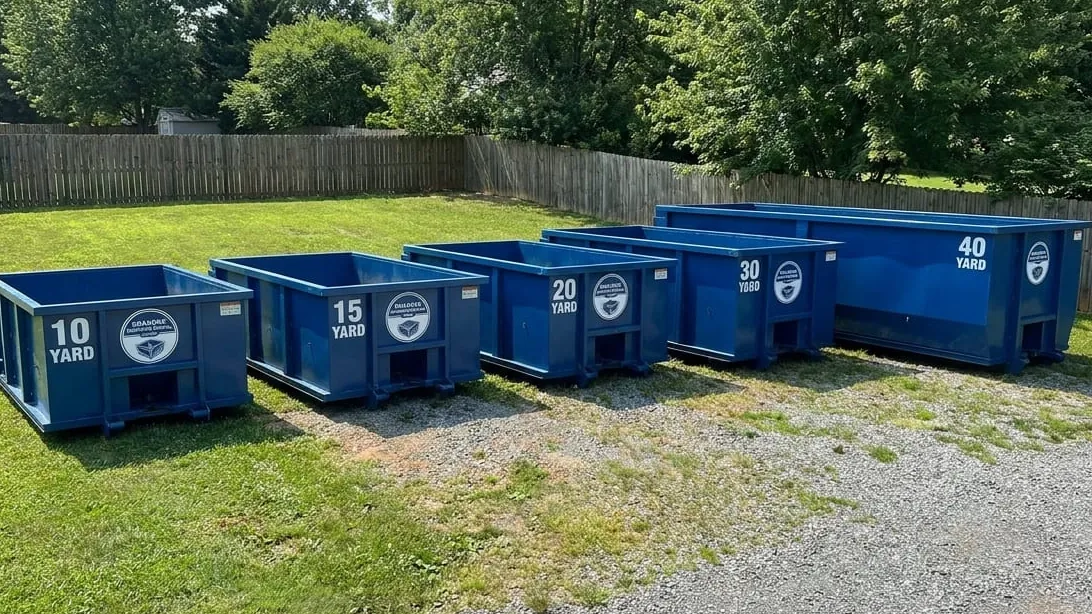
A roofing dumpster is the easiest box in this business to size and the easiest one to get badly wrong, because roofing is the one job where volume is almost irrelevant. You are not renting space. You are renting the ability to move tons.
Two numbers decide everything: how many squares, and how many layers. Give us those and we can size the box over the phone in about fifteen seconds. Everything else on this page is detail around those two numbers.
Squares and layers
A square is 100 square feet of roof surface. Roofers price in squares, order in squares and think in squares, so learn the word. A typical Roanoke Valley bungalow or foursquare might run 15 to 25 squares. A larger county house with multiple gables and a garage can run 35 or more.
A layer is a full course of roofing. Plenty of older houses in this valley carry two, and a few carry three. Every extra layer multiplies the tonnage by roughly the weight of the first one. If you have been told the roof is 20 squares and you find a second layer under the first when you start pulling, your disposal weight just doubled while the roof stayed the same size.
Ask the roofer how many layers are coming off before you order the box. If nobody knows, assume two and be pleased if you are wrong.
What roofing material weighs
These are working approximations, not code figures. Confirm with your roofer for your actual product, because manufacturers vary.
| Material | Rough weight per square, one layer | Notes |
|---|---|---|
| Three-tab asphalt shingle | About 225 to 250 pounds | The common older residential shingle |
| Architectural or dimensional asphalt | About 400 to 450 pounds | Roughly twice the three-tab weight |
| Wood shake | Lighter than asphalt, very bulky | Fills the box before it fills the scale |
| Slate | Very heavy | Small box only, and it goes out on weight fast |
| Concrete or clay tile | Very heavy | Treat like masonry, not like roofing |
| Old built-up or rolled roofing | Heavy and dense when wet | Get older commercial roof assemblies identified first |
Run the arithmetic once and the point becomes obvious. Twenty squares of architectural shingle in two layers is a lot of weight sitting on a roof, and every pound of it has to come down, go into a box, and cross a scale.
Sizing the box
Because roofing goes out on weight, roofing boxes are never loaded to the rails. A tear-off container that looks two-thirds full from the street is often already at its limit. That is normal and it is not us shortchanging you on space.
| Job | Typical box | Watch for |
|---|---|---|
| Up to about 15 squares, single layer asphalt | 10 or 15 yard | Fine on a tight or sloped drive |
| 15 to 25 squares, single layer | 15 or 20 yard | The most common Roanoke tear-off |
| 15 to 25 squares, two layers | 20 yard, sometimes two drops | Weight, not space, is the constraint |
| 25 to 40 squares, or three layers | 20 yard plus a swap, or two boxes staged | Do not try to solve this with one 30 |
| Slate or tile, any size | 10 yard | Treat as heavy debris throughout |
| Commercial flat roof | Site-specific — call | Assembly and insulation type change everything |
Why the 40-yard is not on that list
Notice what is missing from the table above. The 40-yard box does not appear on a residential tear-off, and it is not because we do not have one. A 40 filled with shingles is not a box anybody can legally move. The larger sizes exist for light bulky material. Roofing is the opposite of that. Our general dumpster sizing guide covers the volume side, and all five boxes are on our dumpster sizes page.
Five feet off the eave line
Roofers want the box tight against the house. It shortens the throw, it keeps the debris off the lawn, and it makes for a faster day. There is a limit to how tight, and it is written down.
Virginia’s Statewide Fire Prevention Code is 13VAC5-51, adopting the 2021 International Fire Code, effective 18 January 2024. Section 304.3.3 says containers with an individual capacity of 1.5 cubic yards or more shall not be stored in buildings or placed within five feet of combustible walls, openings or combustible roof eave lines.
The eave line is called out by name in the code text, which makes this the one code section written as if it had roofing jobs in mind. Every roll-off is far above 1.5 cubic yards, so five feet applies to every box on every tear-off in this valley. Plan the tarps and the throw around it. It is not negotiable and it is not hard.
Roanoke roofs are not northern roofs
If your roofing knowledge came from somewhere colder, some of it does not transfer, and the local code says so explicitly.
The City of Roanoke’s local climatic design criteria give a ground snow load of 30 psf and, in plain language, ice barrier underlayment required: NO. Those two entries tell you what kind of roof market this is. The design problem here is not accumulated snow, and it is not the cold-climate roof detailing that northern codes call for.
The numbers behind that come from NWS Blacksburg, which is the forecast office for this area — there is no Roanoke office. On the 1991 to 2020 normals for station ROA, Roanoke averages 14.8 inches of snow a year, 42.82 inches of precipitation, and a mean annual temperature of 58.1 degrees Fahrenheit. You can see the office’s climate material at the National Weather Service.
Fifteen inches of snow a year is not nothing. It is enough to shut a jobsite for a couple of days a winter. It is not enough to plan a whole season around, It is nowhere near enough to make northern winter roof detailing standard practice here. Elevation does matter inside our service area, though — Catawba, Bent Mountain and Poor Mountain sit higher than the valley floor and behave differently.
What actually drives roof replacement here is rain, wind, sun and age. Nearly 43 inches of precipitation a year, remnants of tropical systems reaching the Blue Ridge, ice storms and freeze–thaw cycling, and a housing stock where the City of Roanoke reports 55% of houses were built before 1960. Old roofs on old houses in a wet climate.
Where the box goes on a hillside lot
This is the part of a Roanoke tear-off that goes wrong most often, and it has nothing to do with roofing.
The valley sits between Mill Mountain, Read Mountain, Tinker Mountain, the Blue Ridge and the Alleghenies. In South Roanoke, Grandin Court, Deyerle, Crystal Spring, Garden City and parts of Cave Spring, driveways climb hard off the street. A roll-off delivery is a gravity operation — the box rolls down the rails and stops where the grade lets it stop — and retrieval is the reverse, with the cable pulling a fully loaded container back up the same slope.
A shingle box is the heaviest thing per cubic foot we routinely place on a residential drive. On a steep grade, that argues for a smaller box, loaded flat and loaded low, and swapped more often. It also argues for boards under the rails, because steep asphalt takes more damage than flat concrete does. The whole subject is in our steep driveway delivery guide.
Placement notes for tear-off day
A few things worth settling before the crew arrives:
- Five feet minimum from the eave line and any combustible wall or opening.
- Close enough to the working elevation that the crew is not carrying shingles around the house.
- On the downhill side where possible, so gravity works with the throw rather than against it.
- Off the septic field, and off anything you would not park a loaded truck on.
- Not blocking the only exit from the driveway, because that box may sit for several days.
If the box has to go in the street
Some city lots have no driveway that will take a container near the work. On a narrow street in Old Southwest or Belmont, with a rear alley and eight feet of side yard, the street is sometimes the only option. Before you plan on it, know which government owns that street.
The City of Roanoke is an independent city and is not in Roanoke County. Salem is independent too, and Vinton is a town inside the county. That distinction decides who issues the permit.
In the City of Roanoke, a container in the street, alley or sidewalk needs a permit from the Transportation Division under City Code §§ 14.1-41 through 14.1-46 and § 30-2. The requirements that matter to a roofing schedule are the ten calendar day application lead time, the 30 consecutive day maximum, the certificate of liability insurance of at least $1 million per occurrence naming the City as additional insured, placement at least 30 feet from intersections and crosswalks and 5 feet from driveways, a 10-foot travel lane held open, and traffic cones and reflective tape in place at all times.
Ten days is the one that hurts a roofing job, because roofing gets scheduled around weather and weather does not give ten days notice. In a Roanoke County subdivision the street is usually maintained by the state under the Byrd Road Act rather than by the county, so a street placement there is a VDOT question worth a call to the VDOT Salem District. On a private driveway, in any of the four jurisdictions, you normally need no permit at all — which is one more reason to make the driveway work if it can be made to work.
Scheduling around the weather
Tear-offs are weather jobs. Roanoke gets close to 43 inches of precipitation a year, and an open deck and a rain band do not mix. That has one consequence for the container: the box will probably sit longer than the roof takes.
Plan for that. Order a day ahead of the tear-off rather than the morning of, so a late truck does not idle a five-man crew. Call for the swap or the pull when the box is about three-quarters full, not when it is heaped. And if you are working under a city street permit, remember the thirty-day ceiling includes every rained-out day in the middle.
Older roofs, and the two dates worth checking
Before you tear into anything old, two Virginia dates are worth a moment.
The federal EPA RRP rule covers work disturbing paint in housing built before 1978. Roof work itself is not usually paint-disturbing, but associated work — soffit, fascia, trim, window replacement — frequently is.
Va. Code § 36-99.7 keys off a different year: a locality may not issue a building permit for renovation or demolition of a building whose initial building permit predates 1 January 1985 without a licensed asbestos inspection, though residential buildings of four units or fewer are exempt unless the work is for commercial or public development purposes. Older commercial roof assemblies are where this bites. We do not accept asbestos in our containers under any circumstances.
What to have ready when you call
- Squares, or the footprint and rough pitch if nobody has measured yet.
- Number of layers coming off, or an honest guess.
- Material — three-tab, architectural, wood, slate or tile.
- Neighborhood or community, so we know the jurisdiction and the drive.
- Driveway grade and surface, and whether a box can sit near the eave.
- Start date, and whether you want a swap scheduled in advance.
We put boxes on tear-offs across the valley every week and we would rather size it right than sell you a bigger one. Details on the equipment side are on our roofing dumpster rental page. Call Roanoke Dumpster Rental Group at (540) 685-0739.
Questions this guide did not answer? Call (540) 685-0739. We would rather spend two minutes on the phone than have you order the wrong container.