
Repairs
Termite and Rot Repair Debris in the Roanoke Valley
Sill plate, band joist and subfloor replacement is the signature Roanoke repair. Here is why the debris weighs so much, and why a 10-yard is usually the right container.
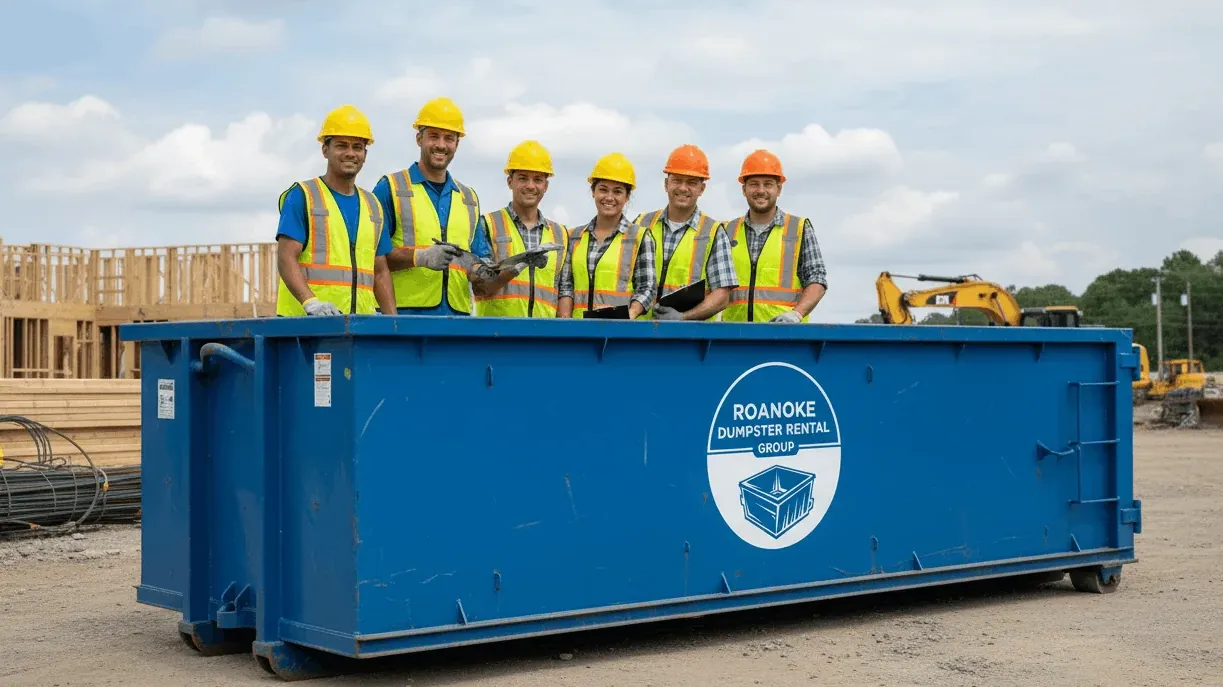
The most Roanoke job there is goes like this. A homeowner notices the hardwood dipping near an exterior wall. A contractor opens the crawlspace hatch, crawls twenty feet, and puts a screwdriver through a sill plate that looks perfectly fine from underneath. Two weeks later there is a small container on the driveway holding about three tons of what used to be the corner of a house.
That is not a freak event here. It is the signature repair in this valley, and the reason is written into the local building code. Call (540) 685-0739 when you know the scope, and we will bring the right box.
Why framing rots in the Roanoke Valley
Three conditions stack here, and each one is documented.
First, termites. Roanoke County, the City of Roanoke, the City of Salem and the Town of Vinton are all designated severe for termite infestation probability in the local Table R301.2(1) design criteria. Not moderate. Not moderate to heavy. Severe, across all four localities in this valley. One ridge west the designation changes, which tells you how local these calls are.
Second, the housing stock. Crawlspaces are common here, and plenty of older city houses have basements. A crawlspace puts wood framing close to bare soil in a dark, still, humid space. That is exactly the environment subterranean termites need, and exactly the environment that keeps wood damp enough for decay fungus.
Third, water. Roanoke averages 42.82 inches of precipitation a year on National Weather Service Blacksburg normals for the Roanoke station, in a mixed-humid climate where heating and cooling degree days are nearly equal. The valley also sits on karst, soluble carbonate rock that moves groundwater fast and unpredictably. Water shows up in a crawlspace after a storm that did nothing to the house two streets over.
Termites and rot are not really two problems. They are one problem with two symptoms. Wood that stays wet gets soft, and soft wet wood is what termites want.
Where the damage actually is
Almost always at the interface between the foundation and the framing. In order of how often we see it:
- The sill plate. The horizontal member bolted to the top of the foundation wall or pier. It is the lowest wood in the house and often the wettest.
- The band joist or rim joist. The board that closes off the ends of the floor joists. It sits directly above the sill and takes water that gets past the siding.
- Joist ends. The last twelve to twenty-four inches of each joist where it bears on the sill. Often you replace the ends and sister on rather than replacing whole joists.
- Subfloor. Diagonal plank subfloor in older houses, plywood in newer. Once the joist ends go, the subfloor above them follows.
- Girders and posts. Center beams and the posts under them, especially where a post sits on a pier with no capillary break.
- Porch framing and steps. Exposed, low, and usually the first thing to fail on an older city house.
- Studs at the bottom of the wall. Once the sill is gone, the bottom eighteen inches of the wall framing often is too.
The damage is bigger than the hole you can see
Nobody replaces exactly the rotten part. You cut back to sound wood, and sound wood is usually two or three feet past where the probe stopped going in. That is why the debris estimate a homeowner makes at the hatch is almost always low by half.
Rotten framing weighs far more than people expect
This is the part that decides your container, and it is the part everybody gets wrong.
Wet wood is heavy wood
Dry framing lumber is not especially heavy. Framing that has been sitting on a damp sill in a crawlspace for fifteen years has taken on water, and it holds that water for weeks after it comes out. A stack of rotten sill plate, band joist and joist ends is not comparable to the same volume of clean construction offcuts. You are hauling water as much as wood.
It comes out dirty
Crawlspace demolition debris arrives caked in soil, old insulation, torn vapor barrier and mud. All of that adds weight and none of it adds volume. If you also pull out old brick piers, block, or a section of failing footing, you have gone from wood debris to masonry debris, which is a different category entirely.
It comes out in short, awkward pieces
You cannot pull an eighteen-foot joist out of a crawlspace with thirty inches of headroom. It comes out in three-foot chunks, cut in place, one at a time, by somebody lying on their back. Short pieces pack a container densely, which is good for volume and bad for weight. A box of three-foot rotten framing sections will hit a weight limit while it still looks half empty.
What a sill plate job actually produces
| Material | Typical scope | Notes |
|---|---|---|
| Sill plate sections | 20 to 60 linear feet | Wet, often with anchor bolts still in them |
| Band joist | Matching run | Comes out in pieces, usually with siding nails |
| Joist ends | 8 to 25 joists | Cut back 18 to 36 inches each |
| Subfloor | 40 to 200 square feet | Plank or plywood, often with finish flooring attached |
| Insulation and vapor barrier | The whole affected bay | Soaked, filthy, and heavier than it looks |
| Brick, block or pier debris | Variable | Only if the foundation itself is being repaired |
| Finish flooring | Room-sized | Hardwood or tile above the repair usually comes up |
Add the fasteners. Old framing comes out full of nails, lag bolts, anchor bolts, joist hangers and strapping. That is a real safety issue on the ground around the box, and a good reason to load as you cut rather than building a pile in the yard.
Why the 10-yard is usually the right box
People see a whole corner of a house coming apart and ask for a 30. That is the wrong instinct for this job.
Rot repair debris is a weight problem, not a volume problem. A 10-yard box is built for dense material. It has the lowest walls, which matters when a crew is throwing three-foot chunks over the side by hand from a crawlspace hatch. It has the smallest footprint, which matters because so many valley driveways are steep, short or cut into a hillside. And it will still be liftable when it is full, which a 20 loaded with wet framing and masonry may not be.
Take the 20 when the repair opens up into a room remodel, when the finish flooring and drywall of an entire room are coming out on top of the framing, or when you are combining the repair with a wider crawlspace clear-out. Sizes and footprints are on our dumpster sizes page, and if the job spreads into general demolition, the demolition debris removal page covers how we run those.
If you are also emptying the crawlspace of old insulation, poly and spoil while you are down there, read our guide to crawlspace and basement cleanouts. It is often the same trip.
Two dates before the saw comes out
Rot repair opens walls and floors. Once you are opening a wall in an older house, two federal and state vintage rules can apply, and they use different dates.
Before 1 January 1985
Under Va. Code § 36-99.7, a local building department shall not issue a building permit allowing a building for which an initial building permit was issued before 1 January 1985 to be renovated or demolished until the department receives certification that the affected portions have been inspected for asbestos by a licensed inspector. The statute then says its provisions shall not apply to single-family dwellings or residential housing with four or fewer units, unless the renovation or demolition of such buildings is for commercial or public development purposes.
Read the exemption exactly as written rather than as a rule of thumb. It is narrow, and it turns on both the number of units and the purpose of the work. A duplex being repaired for its owner is one thing. The same building being gutted as part of a commercial development is another. Ask your building official, not the internet. The full text is on the Virginia Law Portal.
Before 1 January 1978
The federal Renovation, Repair and Painting rule applies to work that disturbs painted surfaces in pre-1978 housing, and it is administered by the EPA in Virginia rather than by a state program. Window replacement and demolition are always covered. Roanoke has no local lead ordinance, so the federal rule is the whole of the requirement here. More than half of City of Roanoke housing was built before 1960, so a great many city rot repairs sit squarely in pre-1978 stock. The rule details are published by the US EPA.
One more notification worth knowing about: in Virginia the Department of Labor and Industry must be notified 10 working days before any demolition, asbestos or not. That is a contractor obligation, not a homeowner one, but it affects your schedule if a structure is coming down rather than being repaired.
What we cannot take
- Asbestos. Never, in any container. In Virginia asbestos work runs through a contractor licensed by the Department of Professional and Occupational Regulation, with notification to the Department of Labor and Industry, and the waste goes to a facility permitted to accept it. Old duct wrap, pipe insulation and nine-inch floor tile in a pre-1980s crawlspace or basement are worth checking before anyone cuts.
- Treated lumber mixed with brush. It can go in our box, but it will not go out at the curb. The City of Roanoke does not take treated lumber, railroad ties or landscape ties with brush collection.
- Liquids of any kind. No paint, no solvent, no fuel. Karst drains fast and unfiltered in this valley, so a leaking container reaches groundwater quickly.
- Lead-acid batteries. The one genuine statewide disposal ban, under Va. Code § 10.1-1425.1, with each battery a separate violation.
Getting the box where the work is
Crawlspace repair happens at the perimeter of the house, which usually means the debris comes out at a side or rear hatch rather than the front door. The closer we can set the container to that hatch, the fewer times a wet chunk of joist gets carried. Tell us which side of the house the access is on when you call.
Two constraints. Fire code requires 5 feet of clearance from combustible walls, openings and roof eave lines for any container of 1.5 cubic yards or more, which is every roll-off there is. And a loaded box is a concentrated point load on karst ground, so we keep containers on prepared surfaces, run plywood under the rails and wheels, and avoid soft ground and settling spots.
If the driveway will not work, a street placement in the City of Roanoke needs a Transportation Division permit, applied for at least 10 calendar days ahead, with $1 million per occurrence liability naming the City as an additional insured. In Roanoke County the residential street is usually maintained by VDOT rather than the county, so a street placement there is a VDOT question for the Salem District.
Sequence the work, not just the container
Fix the water before you replace the wood. New framing put into a wet crawlspace will be back in the container in fifteen years. Grade away from the foundation, get the gutters and downspouts discharging well clear, deal with standing water, and put down a proper vapor barrier lapped and sealed at the piers and the wall.
Then get the pest side treated by somebody licensed to do it, because replacing a sill plate without addressing an active colony is expensive theater.
Then rebuild. And while the space is open, run a radon test. Radon comes out of the same carbonate rock the sinkholes come from and enters through the lowest level of the house. The Virginia Department of Health notes that high radon results have been found in every Virginia county, so location alone will not tell you.
For the disposal side of a larger project, our article on construction debris disposal in Virginia covers the wider rules. When you have a scope, call (540) 685-0739 and tell us how much sill and how much subfloor. We will size it honestly.
Questions this guide did not answer? Call (540) 685-0739. We would rather spend two minutes on the phone than have you order the wrong container.