
Sizes
What Size Dumpster Do I Need in Roanoke? A Local Guide
The 20-yard is the default box in the Roanoke Valley, the 10-yard is for weight, and the 40 needs the flattest ground you have. Here is how to pick.
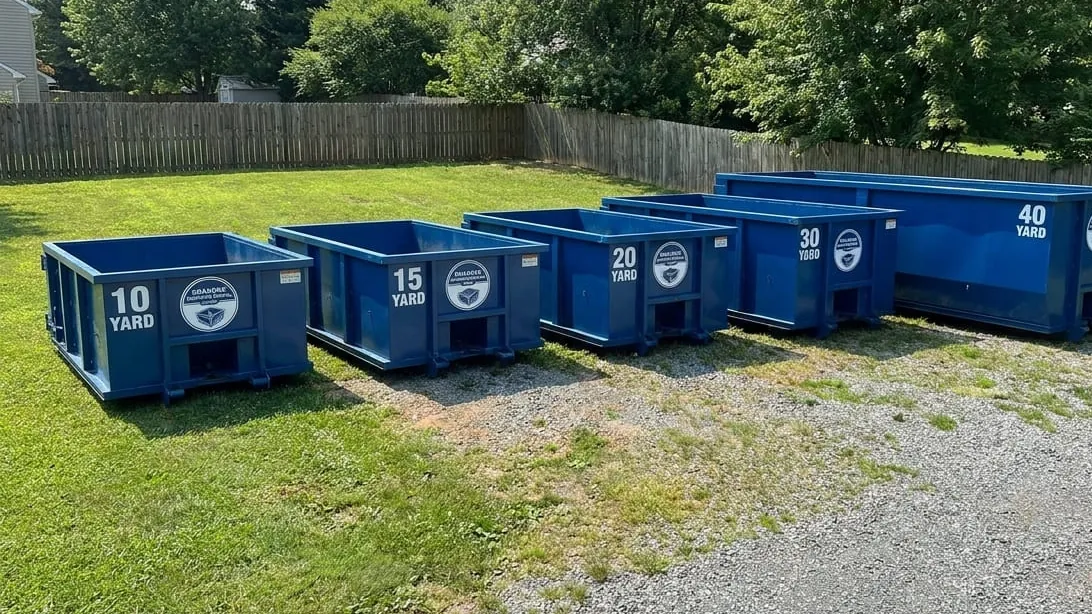
Most people call us with a room in mind and no idea what that room weighs. That is normal. In the Roanoke Valley the size question usually answers itself once you tell us two things: what the material actually is, and where the truck is going to set the box down. The second one matters more here than it does in a flat market, because a lot of driveways between Mill Mountain and Read Mountain are cut into a hillside.
Here is the short version, and then the long one. The 20-yard is the default box in this valley. The 10-yard is the weight box. The 40-yard needs more room and flatter ground than most residential lots have. Everything else is a judgment call about how much handling you want to do.
The 20-yard is the Roanoke default
If you had to guess a size for a Roanoke Valley job sight unseen, you would guess a 20 and you would usually be right. It is the box that fits a multi-room remodel, a crawlspace-and-attic clear-out, a garage that has been filling since the Reagan administration, or a rental turnover with furniture in it.
The reason is partly the housing. The City of Roanoke says on its own housing page that 55% of the city’s houses were built before 1960, out of about 44,543 units, and that the stock runs to foursquares, craftsman bungalows and folk Victorians. Those houses have attics, crawlspaces, back porches and basements, and they have had sixty to a hundred years to accumulate. When you finally empty one, you do not get a tidy single-material load. You get boxes, plaster, old carpet, a water heater, three doors and a bed frame. That is 20-yard work.
Roanoke County is a different market on the same map. Owner occupancy runs about 75.7% there against 52.4% in the city, and median home value is around $286,000 against $190,500, on 2020–2024 American Community Survey five-year figures. County work skews toward owner-occupier renovation rather than landlord turnover. It still mostly lands on a 20.
The 10-yard is the weight box, not the small box
People order a 10 because it sounds cheap and small. That is the wrong reason. Order a 10 because the material is heavy.
A 10-yard box is the right call for concrete, brick, block, mortar rubble, tile, dirt and crawlspace spoil. It is also the right call for the most Roanoke-specific job there is: termite-rotted framing. Roanoke City, Roanoke County, Vinton and Salem are all rated SEVERE for termite infestation probability in the local design criteria. Combine that with a crawlspace-heavy housing stock and humid summers and you get sill plate, band joist and subfloor replacement as a routine job. Wet, rotten, nail-studded framing is far heavier than it looks. A small pile of it will out-weigh a full 20-yard box of drywall.
Two other things make the 10 the smart choice. It has the smallest footprint, so it fits a narrow city lot in Old Southwest or a short driveway in Grandin Court. And it is the box a truck can most reliably retrieve from a steep grade with a full load on it.
Size by size, with the local job that goes in it
10 yard
Roughly a pickup-truck-and-a-half of volume, and the highest weight tolerance per cubic yard. Concrete, brick, tile, dirt, crawlspace spoil, rot repair, a small bathroom gut. The best box on a steep or narrow drive.
15 yard
One room, a small roof tear-off, or one unit of a city rental turnover. Useful when a 10 will overflow on volume but a 20 will never fill.
20 yard
The default. Multi-room remodel, whole crawlspace and attic, garage clear-out, a mid-size tear-off. If you are not sure, this is the one.
30 yard
Whole-house cleanout, a large county remodel, a job with cabinets and framing and carpet all at once. Needs real room to set and real room to swing the door.
40 yard
Commercial gut work and construction. Say it plainly: the 40 needs the most space and the flattest ground of anything we run. On a valley-floor commercial lot it is easy. On a hillside residential driveway it is usually a no, and we will tell you that on the phone rather than after the truck is in your yard.
| Size | Typical Roanoke job | Best for | Ground needed |
|---|---|---|---|
| 10 yard | Concrete, brick, sill plate and band joist repair, crawlspace spoil | Weight | Least — works on tight or sloped drives |
| 15 yard | One room, small tear-off, single rental unit | Mixed light debris in small volume | Modest |
| 20 yard | Multi-room remodel, attic and crawlspace clear-out | General purpose | Moderate, reasonably level |
| 30 yard | Whole-house cleanout, large county renovation | Volume | Generous |
| 40 yard | Commercial gut, construction | Bulk volume, light material | Most, and the flattest |
Volume fills the box, weight decides the bill
A roll-off has two limits. One is the walls. The other is what the truck can legally and safely carry off your street. Light bulky material like insulation, cabinetry, siding and furniture runs out of walls first. Dense material like masonry, plaster, wet lumber and dirt runs out of weight first, often with the box less than half full.
That is not a sales line, it is where the money goes. Construction and demolition debris in this valley is charged by the ton at the scale. The Roanoke Valley Resource Authority published a C&D rate of $64.50 per ton effective 1 July 2022; rates change, so treat that as a concept rather than a current quote and call for today’s numbers. The point stands regardless of the figure: two boxes of the same size can cost very different amounts because one of them holds masonry.
The practical rule we give people is to split materials when you can. Put the concrete, brick and rot-repair framing in a 10 by itself. Put the light bulky material in a 20. You will handle it twice, and you will usually still come out ahead. More on that in our guide to what drives dumpster rental cost in Roanoke.
What the curb will and will not take
Part of sizing a box is knowing what you cannot simply set out on the curb, because that is the material that has to go in the container. Here the answer depends on which government you live under, and the two big ones give opposite answers to the same question.
The City of Roanoke does not collect construction and demolition debris. The City’s own solid waste planning goes further than that and excludes homeowner-generated remodeling materials, land clearing debris, rocks, dirt, sand, brick and concrete, and stumps. City bulk collection is capped at three items a week, and brush has to be under three inches in diameter in a pile no bigger than six feet by six feet by six feet. If you are gutting a bathroom in Old Southwest, none of that helps you.
Roanoke County goes the other way on one specific point: it allows small amounts of debris from homeowner-generated small remodeling or repair work to be set out with bulk collection, which runs on an alternating A-week and B-week schedule rather than weekly. The County still refuses brick, concrete, dirt, sod, rocks and metal. Salem runs a third system and Vinton a fourth.
So the sizing question in the city is often “all of it goes in the box,” and in the county it is sometimes “most of it goes in the box and the odd item can wait for bulk week.” That difference is worth one size on a marginal job. Four governments in one valley, four answers, and they are all correct in their own jurisdiction.
The driveway decides as much as the debris does
Roanoke sits on a valley floor between Mill Mountain, Read Mountain, Tinker Mountain, the Blue Ridge and the Alleghenies. A meaningful share of driveways here are steep, curved, or cut into a hillside. South Roanoke, Grandin Court, Deyerle, Crystal Spring, Garden City and parts of Cave Spring all have streets where the driveway climbs hard off the curb.
Delivery is a gravity operation. The box slides down the rails and stops where the friction and the grade let it stop. On a steep drive that behavior changes, and so does the retrieval, because the cable has to pull a loaded box back up the same slope. A 10 or a 15 loaded flat and low is a very different proposition from a 30 loaded to the rails.
There is a second reason to care where the box sits. This valley is karst country — soluble limestone and dolomite, with caves, springs and sinkholes. Virginia Energy, the state geological authority, notes that subsidence “is generally not covered by a standard homeowner’s insurance policy.” A loaded roll-off is several tons resting on four small contact points. That is a reason to think about placement, not a reason to panic. We cover the whole subject in steep driveway dumpster delivery in Roanoke.
Five feet, every box, every size
Virginia’s Statewide Fire Prevention Code is 13VAC5-51, built on the 2021 International Fire Code and effective 18 January 2024. The rule that reaches your driveway is § 304.3.3: containers with an individual capacity of 1.5 cubic yards or more may not be stored in buildings or placed within five feet of combustible walls, openings or combustible roof eave lines.
Every roll-off we run is far above 1.5 cubic yards. The 10 is above it. So the five-foot rule applies to every box on every job, regardless of size. When you are picking a size, measure the gap between where the box would sit and the wall of the house, not just the length of the pad.
Where the box sits changes the paperwork
This is the part outsiders get wrong. The City of Roanoke is an independent city. It is not in Roanoke County. Salem is independent too. Vinton is a town inside the county. If you want proof that the lines are real, Roanoke County’s courthouse is at 305 E. Main St in Salem.
On a private driveway, anywhere in the valley, you normally need no permit at all. On a City of Roanoke street, alley or sidewalk you need a permit from the City’s Transportation Division, and the paperwork has to be in ten calendar days ahead. In a Roanoke County subdivision the street is usually maintained by the state under the Byrd Road Act, so a street placement is a VDOT question and worth a call to the VDOT Salem District first. Details are in our Roanoke dumpster permit guide, and the City publishes its own material at City of Roanoke.
Size interacts with all of that. A 40 on a city street eats more curb, sits closer to a driveway or a crosswalk, and makes the ten-foot travel lane harder to hold. A 10 or a 15 is often the only realistic street box on a narrow street in Old Southwest or Belmont.
How to pick in about two minutes
- Name the heaviest material. If it is concrete, brick, tile, dirt or rot-repair framing, start at a 10 and stop there.
- Count the rooms. One room is a 15. Two to four rooms is a 20. A whole house is a 30.
- Measure the pad. You want roughly 60 feet of straight approach and clear overhead for the truck, and five feet off the house.
- Look at the grade. If your driveway is steep or curved, drop a size and tell us before we roll.
- Decide where it sits. Driveway is simplest. Street in the city means a permit, ten days ahead.
- When in doubt, go up one size on volume and down one on weight. Space in the box is cheap. An overweight box is not.
You can compare all five boxes on our dumpster sizes page, and if the job is a straight house clear-out, our residential dumpster rental page covers how we handle older city homes with crawlspaces and tight lots.
Or skip all of it and call. Tell us the neighborhood, the material and the driveway, and we will tell you the size. Roanoke Dumpster Rental Group, (540) 685-0739. We have been running boxes in this valley since 2012, and we have opinions about crawlspaces.
Questions this guide did not answer? Call (540) 685-0739. We would rather spend two minutes on the phone than have you order the wrong container.