
Delivery
Steep Driveway Dumpster Delivery in the Roanoke Valley
Most dumpster companies never think about grade. In a valley ringed by ridges, we think about it daily. Here is what a hillside driveway does to a roll-off.
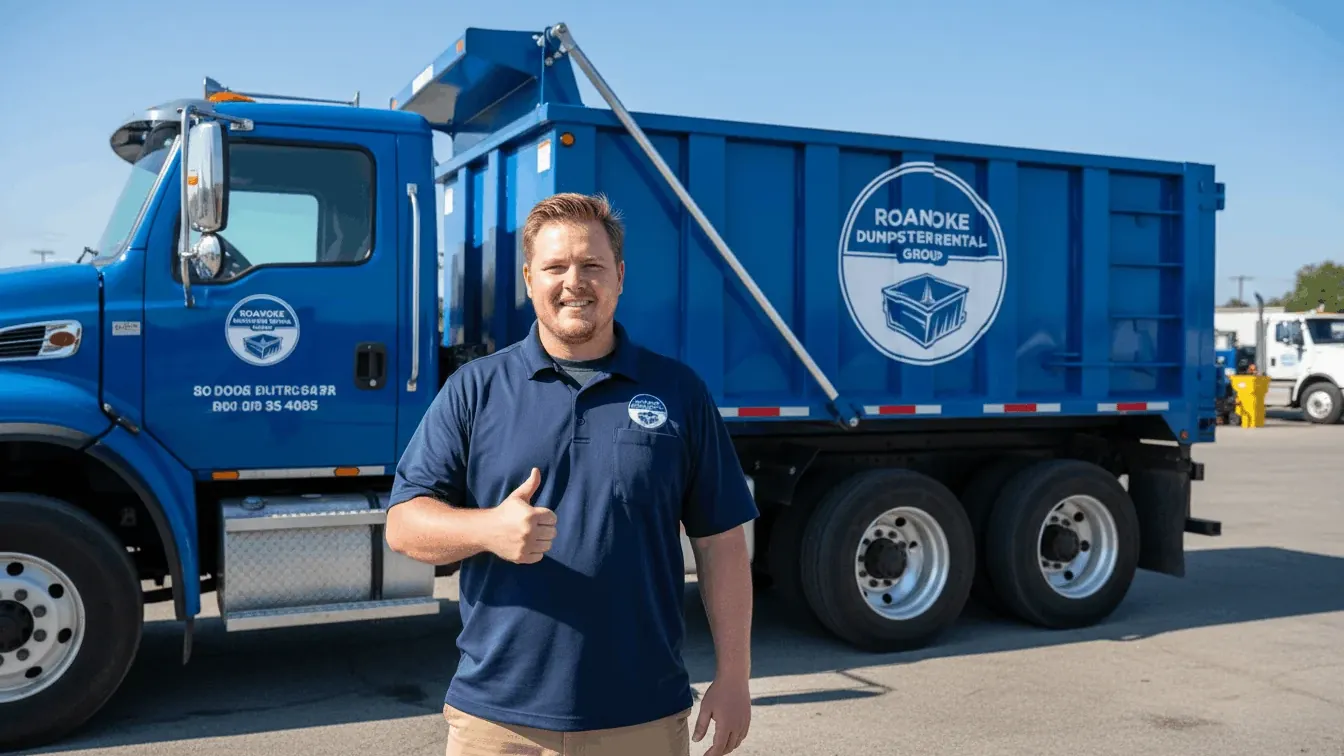
Most dumpster companies in America never have to think about grade. We think about it every day. Roanoke sits on a valley floor ringed by Mill Mountain, Read Mountain, Tinker Mountain, the Blue Ridge and the Allegheny ridges, and a meaningful share of the driveways here are steep, curved, or cut into a hillside. South Roanoke, Grandin Court, Deyerle, Crystal Spring, Garden City and plenty of Cave Spring are full of them.
This page is the operational side of that. It is not code and there is no published grade limit for setting a roll-off — anyone quoting you a legal maximum angle is making it up. What follows is what we have learned running boxes up and down these hills since 2012.
A roll-off delivery is a gravity operation
Understand the mechanics and the rest of this page explains itself.
The truck backs into position. The bed tilts up on hydraulics until the rear rollers touch the ground. The container slides down the rails under its own weight, controlled by the cable, and the truck creeps forward as the box comes off. On flat ground the box stops where the driver puts it.
Retrieval is that in reverse and it is the harder half. The cable hooks the front of the container and winches it up the tilted bed, now with several tons of debris in it. On level ground the winch does the work. On a grade, gravity is either helping the delivery and fighting the retrieval, or the other way around, and it is never neutral.
That asymmetry is the core of the problem. A driveway that takes a delivery beautifully can be a genuine problem four days later when the same box weighs seven tons more.
What grade does, in order
Downhill delivery, uphill retrieval
This is the common Roanoke setup: the house sits above or below the street and the driveway climbs. Setting a box downhill of the truck is easy, sometimes too easy — the container wants to keep going. Pulling it back up loaded is where the truck earns its keep, and where a full 30-yard box becomes a bad idea.
Cross-slope
Underrated and more dangerous than plain grade. A driveway that tilts sideways puts the box down on three corners instead of four, and a container loaded on an uneven bearing does not settle evenly. Cross-slope is why we sometimes ask to place a box across a driveway rather than along it.
The apron transition
Where a steep driveway meets a flat street there is a break in the grade. Long-wheelbase trucks drag there, and a container coming off the rails can catch on the high point and pivot. On some Roanoke driveways the apron, not the slope, is the actual limiting factor.
Curves
A driveway that turns as it climbs cannot be backed straight, and a roll-off has to come off in a straight line. A curved hillside drive with a retaining wall on one side is often a no even when the grade itself would be fine.
Where a box will stay put, and where it will not
A loaded container on a slope is held by friction and by whatever is chocked under it. That is all. There is no brake on a roll-off.
- Dry concrete, moderate grade: generally stable, blocked and chocked.
- Dry asphalt, moderate grade: usually fine, but hot summer asphalt is softer than it looks and the rails will sink in.
- Wet or leaf-covered surfaces: less friction than either of the above. Leaf season here is real and slick.
- Gravel on a grade: the gravel moves. The box moves with it.
- Frozen or frost-heaved surface: unpredictable, and freeze–thaw cycling is one of this valley’s regular winter features.
- Any slope steep enough that you would not leave a car in neutral: we will want to talk about the street instead.
Our rule is simple. If we would not park a loaded truck there overnight and walk away, we do not leave a loaded box there either.
Load flat and load low
On a level driveway, how you load a box is mostly about not exceeding weight. On a hillside driveway it is about the box itself.
When a container sits on a grade, everything inside it migrates downhill. Load the heavy material at the low end and you get a concentrated mass at one corner, an uneven bearing, and a much harder pull on retrieval. Load it high and the center of gravity climbs.
So on any sloped placement:
- Spread the heavy material evenly along the length of the box before anything else goes in.
- Keep the load below the rails. Nothing over the top edge, ever, but especially on a grade.
- Break down bulky items so the load packs rather than bridges. A bridged load shifts all at once.
- Take a smaller box. A 10 or a 15 loaded flat beats a 20 loaded to the rails on a hill, every time.
- Swap more often. Two lighter pulls are safer and usually faster than one heavy one.
The 10-yard box is the hillside box for exactly these reasons, which is also why it is the right choice for concrete, brick and termite-rotted framing. More on that in our dumpster sizing guide.
The ground under the driveway
Here is a Roanoke-specific consideration no flat market has to think about. The valley sits in Virginia’s karst belt — soluble limestone and dolomite, which is why we have caves, springs and sinkholes. Virginia Energy, the state geological authority, notes that sinkhole collapse can damage buildings, highways and utilities, and adds a line worth reading twice: subsidence “is generally not covered by a standard homeowner’s insurance policy.” Roanoke County publishes its own karst areas mapping, which tells you the hazard is local rather than theoretical.
A loaded roll-off is several tons resting on a handful of small contact points. On ground that may be bridging a void, that is a concentrated point load in a place that has never carried one. We are not saying your driveway is going to swallow a dumpster. We are saying that on karst ground, where the box goes is a decision worth thirty seconds of thought, and that spreading the load with boards is cheap insurance.
Protecting the surface
Steep asphalt takes more punishment from a roll-off than flat concrete does, because the rails bear harder and the wheels work harder. Protection is straightforward:
- Boards or plywood under the rails at the contact points, and under the rear wheels where the truck bears.
- Two-by material or thick ply, not thin sheets that crack under load.
- Avoid the hottest part of a summer day on new or dark asphalt if the schedule allows.
- Sweep the placement area of gravel and grit first, since loose material grinds into the surface.
We cover the full method in driveway protection during dumpster delivery. Ask for boards when you order. It is a small ask and it saves arguments.
Clearances the truck needs
Grade is only one of four things that decide whether a placement works. The others get overlooked.
| What we need | Roughly | Why |
|---|---|---|
| Straight approach | About 60 feet | The truck and box come off in a straight line |
| Width | About 10 to 12 feet | Truck body plus room for the driver to work |
| Overhead clearance | About 22 feet | The bed tilts up before the box comes off |
| Clear at the back | Length of the box plus several feet | The container needs somewhere to land |
Overhead is the one people forget. Mature trees, low utility drops and porch overhangs stop more deliveries in older Roanoke neighborhoods than grade does. Walk the route and look up before we come.
Season changes the answer
A driveway is not one thing all year. The same grade behaves differently in February than it does in August, and on a hillside that difference is the whole margin.
Winter. Roanoke averages 14.8 inches of snow a year on the 1991 to 2020 normals for station ROA, published by NWS Blacksburg — the forecast office for this area, since there is no Roanoke office. That is enough to shut a jobsite for a couple of days a winter and not enough to plan a season around. The bigger winter issue on a hill is not accumulation, it is freeze–thaw and the thin glaze that forms on a shaded north-facing drive after an ice storm. We will reschedule a steep placement rather than gamble on it, and we do not consider that a hard call.
Fall. Leaf season is genuinely slick. A wet layer of leaves on sloped asphalt has less grip than the same asphalt under rain, and it hides whatever is underneath. Clear the placement area before delivery day.
Summer. Heat softens asphalt. On a steep drive with a dark surface, a hot afternoon is the worst time to set rails down without boards under them.
Storms. The valley takes close to 43 inches of precipitation a year and gets the remnants of tropical systems reaching the Blue Ridge. Roanoke knows what that can do. In November 1985 the Roanoke River crested at 23.35 feet against a 10-foot flood stage, on 6.61 inches of rain in 24 hours — still the record — with at least ten deaths in the valley, and the answer to it was the USACE Roanoke River Flood Reduction Project. After a heavy storm we look hard at saturated ground, undercut driveway edges and washed-out gravel before setting a box anywhere near a slope.
When the driveway is a no
Sometimes it just is, and we would rather say so on the phone than discover it with a truck across your neighbor’s lawn. When the driveway cannot take a box, there are three options.
Use a flatter part of the property. A level parking pad, a turnaround, a side yard with a solid surface. Often there is a spot nobody thought of.
Use the street. This is where jurisdiction matters, and where outsiders get Roanoke wrong. The City of Roanoke is an independent city and is not in Roanoke County. Salem is independent as well, and Vinton is a town inside the county.
On a City of Roanoke street, alley or sidewalk you need a permit from the City’s Transportation Division, under City Code §§ 14.1-41 through 14.1-46 and § 30-2. Apply at least 10 calendar days ahead. A dumpster may stay a maximum of 30 consecutive days. You need liability insurance of at least $1 million per occurrence naming the City of Roanoke as additional insured. The box sits at least 30 feet from stop signs, stop bars, crosswalks and intersections and at least 5 feet from driveways, a 10-foot travel lane stays open, and traffic cones and reflective tape are required at all times. The City does not publish the fee — contact the Transportation Division or see City of Roanoke.
In a Roanoke County subdivision the street is usually maintained by the state under the Byrd Road Act of 1932, not by the county, so a street placement is a VDOT question and worth a call to the VDOT Salem District first. Full detail is in our Roanoke dumpster permit guide.
Or stage it. Park the box somewhere workable and move the material to it. On a truly impossible drive this is often the cheapest answer, even counting the extra handling.
What we will ask before we roll
- How steep, in plain terms — can you walk up it carrying something heavy without thinking about it.
- Asphalt, concrete or gravel, and what condition.
- Does the driveway curve or tilt sideways.
- How long and how wide, and what is overhead.
- Where does the box need to be relative to the work.
- Which jurisdiction, in case we end up in the street.
Send a photo from the street and another from the top if you are unsure. Ninety seconds on the phone saves a wasted truck roll, and a wasted truck roll is the most expensive thing that happens in this business.
We place boxes on hillside driveways across the Roanoke Valley every week and we will tell you honestly when yours is not one of them. Call Roanoke Dumpster Rental Group at (540) 685-0739, or read more about the equipment on our roll-off dumpster rental page.
Questions this guide did not answer? Call (540) 685-0739. We would rather spend two minutes on the phone than have you order the wrong container.