
Storm
Flood and Storm Cleanup in the Roanoke Valley
The Roanoke River crested at 23.35 feet in November 1985 against a 10-foot flood stage. Here is how to work a flood or storm cleanup in this valley, and how to size the box.
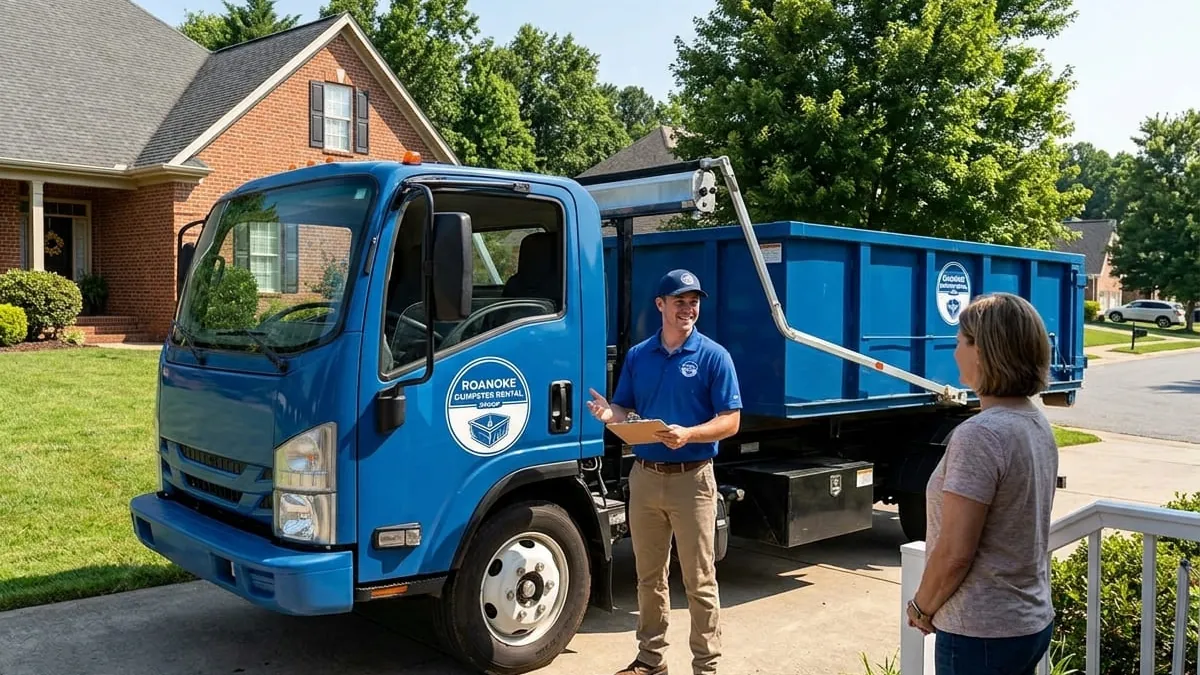
On Election Day 1985 the Roanoke River crested at 23.35 feet. Flood stage is 10 feet. Roanoke took 6.61 inches of rain in 24 hours, which is still the standing 24-hour rainfall record for the city, and at least ten people in the Roanoke Valley died. Anybody here long enough remembers it, and anybody who bought a house near the river has heard about it.
That is the frame for every flood conversation in this valley. Storm cleanup here is not a theoretical exercise. Call (540) 685-0739 and we will get a container to you. This page is about what to do while you wait for it.
What happened in 1985, and what happened afterward
The event began with the remnants of a tropical system saturating the ground over the first days of November, followed by the main rainfall on the fourth. National Weather Service Blacksburg, which is the forecast office for Roanoke, published a formal review of it. The river rose fast, the damage across the Roanoke Valley ran into the hundreds of millions of dollars, and the valley changed how it thought about the river.
The response was the Roanoke River Flood Reduction Project, a congressionally authorized project built by the US Army Corps of Engineers with the City of Roanoke. Construction began in 2005 and continued for years, involving channel geometry changes, bench cuts and floodplain work through the urban reach of the river. It has reduced risk. It has not removed it.
Climate normals for the Roanoke station, published by National Weather Service Blacksburg, put annual precipitation at 42.82 inches. That falls in a narrow valley ringed by mountains, and every drop of it runs downhill into the same place.
The three storms that actually cause work here
Tropical remnants
This is the big one, and 1985 is the proof. A tropical system does not have to make landfall anywhere near Virginia to matter. It has to run out of steam over the Blue Ridge and drop its water on already-saturated ground. Orographic lift over the ridges wrings rainfall out of a decaying storm, and the valley collects it. Late summer and fall are the season.
Ice storms and freeze-thaw
Roanoke averages 14.8 inches of snow a year on the 1991 to 2020 normals. That is enough to shut a jobsite down for a couple of days a winter, not enough to plan a season around. The local design criteria list a ground snow load of 30 psf and state that ice barrier underlayment is not required. So this is not a heavy-snow market and roof snow load is rarely the issue.
Ice is a different matter. Freezing rain in a valley between ridges brings down limbs and whole trees, and that is where the debris comes from. Repeated freeze and thaw is the other winter story: it spalls concrete, cracks driveways, heaves masonry and pops brick. That damage accumulates quietly and shows up as a repair project in the spring.
Summer thunderstorms and wind
Straight-line wind through a valley with mature canopy takes down large old trees onto roofs, cars and fences. That produces two very different debris streams at once: clean woody material, and roof and structural debris with nails in it.
Before you touch anything
- Do not enter a flooded structure until the power is off and somebody competent has said the building is safe. Water and electricity in a basement is how people die after the storm rather than during it.
- Photograph everything before you move it. Every room, every wall, every appliance, with the water line visible. Insurance and any assistance program will want it and you will not get a second chance.
- Call your insurer before disposal. Standard homeowner policies do not cover flood, and separate flood coverage has its own rules about documentation.
- Wear real protection. Boots, heavy gloves, eye protection and a respirator. Flood water in a developed valley is not clean water.
- If any part of the work involves digging or taking down a structure, call Virginia 811, still known here as Miss Utility. Va. Code § 56-265.19 A requires the scheduled date to be not less than 48 hours nor more than 12 working days after the notice, and a ticket runs 15 working days. Demolition is expressly covered, not just excavation.
Wet debris weighs two to three times what dry debris weighs
This is the single most useful thing on this page, and it is the mistake almost everyone makes after a flood.
Saturated drywall, wet carpet and pad, soaked insulation, waterlogged subfloor and swollen particleboard furniture are all heavy in a way that dry versions of the same material are not. A container that would hold a whole first floor of dry demolition debris will hit its weight limit less than half full when the same material is wet. Weight, not volume, is the constraint on a flood job.
Three consequences follow from that.
- Take a smaller box than your eyes tell you to. Two 10-yard or 20-yard pulls will usually beat one 30 that cannot be lifted.
- Load flat and load low. Spread wet material along the floor of the container rather than stacking it at one end, especially on a sloped driveway.
- Let material drain before it goes in. Carpet especially. An hour on a slope outside sheds a surprising amount of water.
Tarp the box
A container full of flood debris left open through the next rain gets heavier every hour, and a load that cannot be covered cannot legally leave. Keep it tarped between sessions. There is a second reason here that most markets do not have: this valley sits on karst, and Virginia Energy describes the Valley and Ridge as extensive karst terrain underlain by limestone and dolomite. Water in karst moves fast and unfiltered, so what leaches out of an open container of wet debris can reach a spring or a well quickly. Keep liquids out of the box and keep the box covered.
Contents and structure are two different jobs
Separate them from the start. They have different timelines, different documentation needs, and different disposal routes.
| Contents | Structure | |
|---|---|---|
| What it is | Furniture, appliances, clothing, boxes, electronics, bedding | Drywall, insulation, flooring, subfloor, cabinets, trim, framing |
| Timeline | Immediately, once photographed | After drying and after any inspection |
| Insurance | Itemized, often with a separate limit | Usually the structural claim |
| Container | Bulky, light, fills volume fast | Dense, wet, hits weight limits fast |
For the structural side, the rule of thumb is to cut drywall at least a foot above the highest water line, and higher if the wall cavity insulation is wet, because water wicks upward. Wet fiberglass never dries usefully in a closed cavity. Pull it. Solid hardwood over a wet subfloor is usually lost. Cabinets with particleboard boxes are almost always lost even when the doors look fine.
Crawlspaces and basements after water
Crawlspaces are common in this valley, and plenty of older city houses have basements. Both are where the water goes and both are where it stays. Standing water in a crawlspace has to be pumped and the vapor barrier is usually a total loss. Wet insulation in the joist bays comes out, and it comes out several times heavier than it went in. Our guide to crawlspace and basement cleanouts covers what that material is and what it weighs.
If the water sat long enough for framing to be affected, you may be into sill plate and band joist territory, which is its own repair with its own debris profile.
What can and cannot go in the container
Virginia is unusual here. The state solid waste regulation, 9VAC20-81, regulates disposal facilities rather than materials, so the Commonwealth has essentially no list of banned products. That said, the exclusions that do exist are firm.
- Yes. Wet drywall, insulation, carpet and pad, subfloor, cabinets, trim, flooring, ruined furniture, mattresses, bagged household goods, appliances with doors removed, fencing and clean woody debris.
- No liquids. Pump water out separately. Nothing pourable goes in the box.
- No lead-acid batteries. That is the one genuine statewide disposal ban, Va. Code § 10.1-1425.1, and each battery is a separate violation. After a flood that means the car battery, the mower battery and the marine battery.
- No paint, fuel, oil, antifreeze, solvents or pesticides. Virginia has no producer-funded paint take-back program, so leftover paint has no retail drop-off here.
- No asbestos. We never take it in any container. If a pre-1980s basement has wrapped duct insulation, old pipe lagging or nine-inch floor tile that got wet and broke up, stop and get it assessed.
- No propane tanks or pressurized cylinders.
Household hazardous waste in this valley goes to the Roanoke Valley Resource Authority at the Tinker Creek Transfer Station on Hollins Road. A short list is taken during normal operating hours and a wider list at scheduled events that require registering ahead. Check current rules with the Roanoke Valley Resource Authority before you drive over with a truckload. Everything that does go in a container leaves this valley by train, hauled 33 miles by Norfolk Southern rail from Tinker Creek out to the Smith Gap Landfill.
Do not count on curbside collection after a storm
Four governments share this valley and they do not answer the same way. The City of Roanoke is an independent city and is not part of Roanoke County. Salem is also independent. Vinton is a town in the county.
The City of Roanoke allows three bulk items a week and weekly brush with a size limit, and its solid waste plan excludes construction, demolition and remodeling debris entirely. Roanoke County collects bulk and brush on an alternating two-week schedule and does allow small amounts of homeowner remodeling debris with bulk pickup. Salem and Vinton run their own systems. After a real flood, none of those schedules will keep up, and special storm collection is not something to assume. Get a container.
Getting a box in after a storm
Two practical notes. First, ground conditions. After heavy rain a lawn will not hold a loaded container and a soft driveway edge will rut. We put plywood under the rails and wheels on residential sets, and after a storm that matters more than usual. Our article on driveway protection during delivery covers the details, including the roughly 60 feet of approach and 20 feet of overhead clearance a truck needs.
Second, placement rules do not go away because there has been a storm. Fire code still requires 5 feet of clearance from combustible walls, openings and roof eave lines for any container of 1.5 cubic yards or more, which is every roll-off. A street placement in the City of Roanoke still needs a permit from the Transportation Division, normally applied for at least 10 calendar days ahead, with $1 million per occurrence liability naming the City as an additional insured, cones and reflective tape at all times, and a 10-foot travel lane. In Roanoke County the street is usually maintained by VDOT rather than the county, so ask the VDOT Salem District. If timing is tight, tell us on the phone and we will work the placement around it.
For sizing, most flood jobs land on a 20-yard for a first floor, or a 10-yard when the material is dense and saturated. Footprints and weights are on the dumpster sizes page. Call (540) 685-0739, tell us how much water and how far up the wall, and we will bring the right box.
Questions this guide did not answer? Call (540) 685-0739. We would rather spend two minutes on the phone than have you order the wrong container.